Maintaining a commercial vehicle involves a complex checklist of mechanical and safety standards, but few are as immediately visible to inspectors as your illumination system. The Federal Motor Carrier Safety Administration’s (FMCSA) DOT lighting requirements for trucks ensure that every power unit and trailer remains recognizable under all environmental conditions.

These rules serve as a critical safety foundation, allowing other motorists to judge your vehicle’s size, speed, and direction from a distance. Failing to maintain these standards increases your risk of a collision and makes your vehicle a target for roadside inspections. Lighting violations are among the most frequently cited issues during DOT stops, contributing significantly to a carrier’s CSA score.
By understanding the specific placement, color, and functionality required for each lamp, you can avoid costly out-of-service orders and keep your operations moving efficiently.
Proper Configuration for Forward-Facing Headlamps
The most basic component of the lighting system is the headlamp assembly. Federal law requires every power unit to have at least two white headlights, one on each side of the front of the vehicle. These must be capable of switching between high and low beams, and they must be mounted at a height between 22 and 54 inches from the ground.
These lamps must be aimed correctly. Headlamps that are misaligned can fail an inspection just as easily as a burnt-out bulb because they pose a hazard to oncoming traffic by causing glare.
In addition to the main headlamps, amber turn signals are required on the front corners. These dual-purpose lamps also act as hazard warning flashers.
Rear-Facing Safety and Signal Requirements
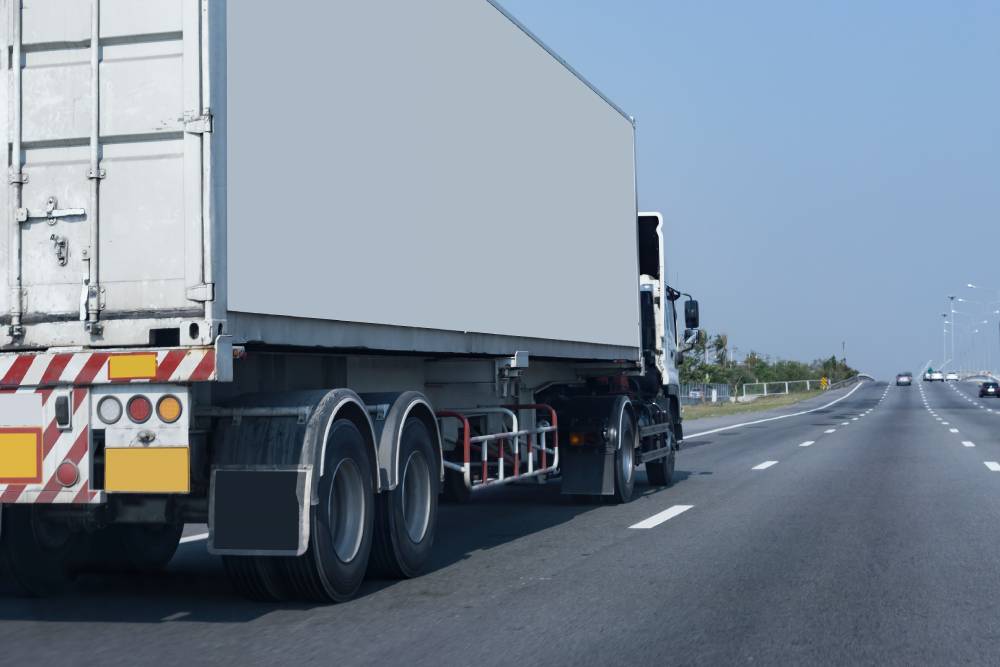
The back of a truck or trailer is a high-risk area for rear-end collisions. Every vehicle must be equipped with two red tail lamps, two red stop lamps, and two red rear turn signals.
In many modern configurations, these functions are combined into a single housing, but they must each perform their specific role clearly. The stop lamps must activate immediately upon application of the service brakes and be visible from at least 500 feet away in normal sunlight.
A white license plate lamp is also mandatory to ensure the rear plate is legible from 50 feet. Furthermore, the rear must feature red reflectors and red clearance lamps at the widest points of the vehicle.
Clearance and Marker Lamp Placement
Clearance and marker lamps define the height and width of a commercial vehicle. According to DOT lighting requirements, amber clearance lamps must be placed at the front of the vehicle to indicate its extreme width and height.
Conversely, red clearance lamps serve the same purpose at the rear. Side marker lamps are also required to show the full length of the unit. These must be amber at the front and mid-point, and red at the rear-most side.
These lamps are essential for night driving and low-visibility conditions. Without them, a long trailer might appear as a disconnected set of headlights and taillights to a driver approaching from the side. These markers provide a continuous visual outline of the tractor-trailer combination, which is a major factor in preventing side-swipe accidents during lane changes or turns.
DOT Lighting Requirements for Flatbed Trucks
Flatbed trailers often struggle with lighting compliance due to their low profile and the lack of a permanent upper structure. To satisfy the specific DOT lighting requirements for flatbed trucks, markers and reflectors must be integrated into the side rails and the rear underride guard. Because there is no roof for identification lamps, these trailers must use the frame’s highest available points to satisfy width requirements.
The challenge with flatbeds is the vulnerability of the lighting fixtures. During loading and unloading with forklifts or heavy machinery, it is common for side markers to be smashed or wiring to be pinched.
Operators must be diligent in checking that the amber markers at the front and middle, as well as the red markers at the rear, remain intact. If a load is wider than the trailer itself, additional temporary lights or flags are often necessary to maintain legal operation.
Conspicuity Tape and Reflective Material Standards
While active lighting is the primary focus, passive reflective materials are equally important under federal law. The DOT requires conspicuity treatment on the sides and rear of all trailers and the rear of all tractors.
This usually takes the form of red and white retroreflective tape, often called DOT-C2 tape. This material must be applied to at least 50% of each side of a trailer and across the full width of the rear lower underride guard and the rear bulkhead.
Reflective tape serves as a backup in the event of a total electrical failure. If a truck is parked on the shoulder of a dark highway without power, the tape ensures that oncoming headlights will illuminate the rig’s presence.
Inspectors look for tape that is peeling, faded, or covered in road grime. Keeping this tape clean and properly applied is one of the simplest ways to stay compliant and improve overall road safety.
Managing Fleet Health with DOT Compliance Services
The complexity of maintaining hundreds of bulbs and thousands of feet of wiring across a fleet is a challenge for any maintenance department. DOT compliance services are a strategic asset that allows carriers to move away from reactive repairs and toward a predictive maintenance model.
Express Compliance provides the tools to track inspection cycles and ensure that lighting issues are caught during pre-trip checks rather than at a weigh station. We work with you to ensure that every vehicle in your inventory meets the highest safety benchmarks.
We help organize maintenance records and driver qualification files so that you are always ready for a federal audit. Our team focuses on total documentation and equipment readiness to protect your business’s reputation and bottom line.
Professional Maintenance and Regulatory Success
Ensuring that your fleet meets every federal standard is a hallmark of a professional transportation company. By treating lighting requirements as a priority, you reduce the risk of accidents, lower your insurance liability, and maintain a cleaner safety profile.
If you are looking for a partner to help you manage the complexities of federal equipment standards, we are here to provide the clarity you need. Our experts can help you streamline your compliance tasks and keep your drivers focused on the road ahead. Contact us today to find out how we can support your fleet’s long-term success.